Artist Profile
Anne Stewart – Artist Profile
My Practice has evolved as a multi-disciplinary practice, consisting of Painting, Drawing Photography, Audio recording, Video, Sound installation, and sculptural installation.
I use these disciplines as an artistic response to research of any subject. I am particularly interested in a sense of place, belonging, community, heritage, folklore, and traditions. These elements are fast disappearing as the older generations are passing on and with them the folklore, way of life and traditions are going into the grave with them.
I have researched archives in County Clare library and interview anyone who have been willing and interested in the preservation of Irish heritage. This interest derives from my experience as a child growing up in Belfast during “The Troubles”. The rejection and isolation I encountered was simply because I was of a different religion from the population/area where I lived. My whole family never felt part of this community or a sense of pride or belonging. My family moved to Shannon County Clare in 1973, and after fourteen years I moved to Kilkishen County Clare and adopted this community as my new home in 1986. I am glad to say I finally feel a sense of pride and belonging within the community of Kilkishen.
I have attended Limerick school of art and design for six years. In that time I was successful in achieving a B.A. honours degree, I continued to progress and achieved a Masters of Fine art.
Burren View Painting
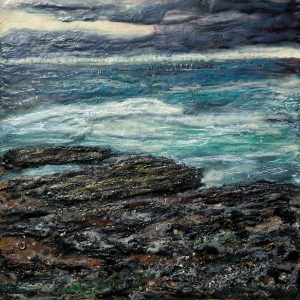
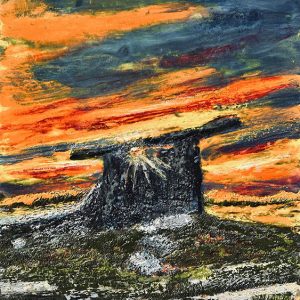
Encaustic painting is an ancient painting technique that involves using heated beeswax mixed with pigments to create artworks. The term “encaustic” comes from the Greek word “enkaustikos,” which means “to burn in.” This technique is characterized by the application of pigmented wax, which is then fused to a surface by heating it. This process can be repeated multiple times, creating layers of color and texture.
Materials and Techniques
The primary materials used in encaustic painting are beeswax, damar resin, and pigments. The beeswax is first cleaned and filtered to remove impurities. Then, damar resin is added to increase the wax’s hardness and durability. Pigments are then mixed into the wax to create a variety of colors.
The encaustic medium can be applied using a variety of tools, such as brushes, palette knives, or heated styluses. Once applied, the wax must be heated to fuse it to the surface. This can be done using a heat gun, a torch, or an electric iron. The heat causes the wax to become fluid again, allowing for additional layers to be added and fused together.
Advantages and Challenges
Encaustic painting has several advantages over other painting techniques. One of the primary advantages is that it allows for a wide range of textures and effects that cannot be achieved with other media. The wax can be manipulated while still hot, allowing for the creation of raised surfaces, lines, and patterns. Additionally, encaustic paintings are highly durable and resistant to moisture, making them ideal for use in high-traffic areas or areas with high humidity.
Showing all 15 resultsSorted by latest
-

View from Doolin
€1,100.00 -
Wild Atlantic Way
€1,100.00 -
Poulnabrone Dolmen, Burren, Co. Clare
€1,650.00 -
Sold
Burren Coast
-
View from Lake Road
€980.00 -
Track to Mullaghmore
€980.00 -
Burren Sunrise
€1,100.00 -
Atlantic Swell
€1,200.00 -
Sold
Along the Atlantic shore
-
Wild & Free
€200.00 -
Turlough, Burren
€345.00 -
Mullagh Mor
€345.00 -
Sold
In between Showers, Burren Series
-
View of Ballyvaughan, Co. Clare
€500.00 -
Mullagh Mór – Changing Light
€780.00